Post also available on Substack.
* * *
In Part 1 we discussed just some of the behind-the-scenes shenanigans that have manoeuvred Andy Burnham into position to seize the job of UK Prime Minister. Consistently unpopular with the British citizenry and repeatedly overlooked by his own party, not a single vote has been cast to put Prime Minister Andy Burnham into the highest office in the land. His Parliamentary Labour Party (PLP) colleagues haven’t even voted for him to lead their party.
In 2017, while he was first campaigning to become the mayor of the Greater Manchester Combined Authority (GMCA), Burnham’s primary pledges were to “give real power to the people,” “to end rough-sleeping by 2020,” and to invest in the people and “young citizens.” This superficial policy program remained a theme throughout his nine years as mayor. Burnham didn’t fulfil any of his promises.
Also in Part 1, we noted the pitiful turnouts for the GMCA elections Burnham has supposedly “won.” Burnham’s mayorship has hardly enthused and certainly does not sociopolitically empower the GMCA region’s people.
In the 2026 first post-Burnham mayoral election, of the 533,326 people who expressed an interest, 251,449 registered voters elected Labour candidate Bev Craig—as their first preference—to be the new mayor of the GMCA. With an electorate of 2,142,779 voters, less than 25% of eligible people voted, and Mayor Craig was endorsed by just under 12% of the GMCA’s population. Nine years of Burnham’s Manchesterism have driven more people away from the polling booths. The overwhelming majority—75% of the people living under the GMCA’s rule—remain completely detached from Manchester’s devolved political circus.
The will of the people is to disengage from the political system. This expressed desire is simply ignored, both at the national and devolved regional levels, by the political class—for obvious reasons—and the media. The representative democratic process evidently does not empower the people; it binds them to laws and regulations without their consent.
[Such is representative democracy. Perhaps we should choose to live in a democracy instead?]
Burnham’s pledge to end rough sleeping was a PR stunt that went wrong. The street homeless are the most visible homeless people but represent only a small fraction of the homeless population. If we consider those living in temporary shelters, those sofa-surfing, squatters and many more who have unwillingly dropped off the grid, homelessness is an endemic problem in this country, especially in Manchester.
Burnham’s flagship “rough sleeping” policy piggy-backed on a national initiative called Housing First to temporarily rehouse the street homeless. Quite possibly, Burnham’s team judged that by narrowing the focus of tackling homelessness solely to reducing “rough sleepers,” they could easily claim success. During Covid another national programme, named Everyone In, dramatically reduced street homelessness, providing the Burnham team with a fortuitous policy boost.
During Covid, Everyone In saw 37,000 people moved into temporary accommodation across the country. The initiative had its funding withdrawn after Covid, and street homeless figures climbed again. Plainly, street homelessness could be largely remedied with the proper resources, but, beyond creating the false impression of an emergency state, national government, local governments, and politicians don’t care.

Nonetheless, using a statistical one-night snapshot, in Manchester, thanks to these initiatives, rough sleepers dropped from 268 per night in 2017 to 90 in 2021. Burnham and his advisors claimed victory, but the reductions weren’t unique to Manchester. Manchester followed the national pattern.
In keeping with that pattern, from 2021 to 2025 the number of rough sleepers in Manchester increased every year, reaching 197 per night in 2025. Burnham’s tenure as mayor saw a measurable increase in homeless street deaths, and by 2023, 1 in 74 people in Manchester were homeless. Homelessness has long been a problem in Manchester, and it still is today. There has been no notable improvement.
Burnham has made a great show of donating 15% of his mayoral salary to homeless causes—though with an estimated personal net worth of a couple of million or so, the donation presumably wasn’t too onerous for him and his family. Burnham’s wife, Marie-France von Heel, is also a multimillionaire in her own right. Though such wealth is relatively meagre for a Westminster political family, it does put Burnham’s widely reported generosity into perspective.
Burnham has run half-marathons and engaged in numerous high-profile photo opportunities to raise money for homeless charities and to ingratiate himself with the public. Notwithstanding, as a politician, his efforts have achieved nothing to address homelessness in Manchester. Added to this, his economic policies have only exacerbated inequality of opportunity—we’ll get to this in a bit.
Yet another empty promise was Burnham’s pledge to invest in young people. Shortly we’ll discuss the alleged economic success of Burnham’s Manchesterism, but, in brief, there is no evidence that young people benefitted from his time as mayor. Across the ten metropolitan districts and boroughs of the GMCA region—Bolton, Bury, Manchester, Oldham, Rochdale, Salford, Stockport, Tameside, Trafford, and Wigan—the figures for young people Not in Education, Employment, or Training (NEETs) are some of the worst in the UK and a persistent sociopolitical problem that Burnham never tackled.
Virtually as he was exiting the door from the Mayor’s office, Burnham said, “We need a complete rethink of how we support the next generation to succeed.” At that point, Burnham had spent nine years purportedly thinking about it.
Despite Burnham’s marked lack of popular support and irrespective of the abject failure of his key policy commitments, few politicians have enjoyed such consistent and broad media backing. The UK mainstream media (MSM) and its social media partners combine to form a single cohesive propaganda and gatekeeping operation. It is clear that there has been a comprehensive, multiyear media and social media campaign to create the Andy Burnham mythology. His public image, notably since he first became GMCA mayor in 2017, has been carefully managed over the years in preparation for him taking the top political job in the UK.
Though some sections of the press remain highly critical of him, as the evidence will show, between May 2017 and June 2026, the volume of propaganda designed to manipulate the population into perceiving Burnham as a political maverick and a “man of the people” has been remarkable. Simultaneously, the alleged success of Manchesterism, as a political strategy, has been assiduously seeded into the public’s consciousness.
Some of the puff pieces written for Burnham have been cringeworthy. As just one among many examples, take the May 2017 Burnham propaganda published by the Manchester Evening News (MEN). Readers in the GMCA region were told that Burnham commands huge majority support—a completely false statement. His marriage was framed as cute—“(awww….bless).” People were informed he had “fluttering, dark eyelashes, perfectly-shaped eyebrows and boyish good looks” and that the donations his political campaigns had received from sports celebrities were amazing.
Burnham was officially sworn in as mayor of the GMCA on the 8th May 2017. Sixteen days later the nation was horrified by the reported bombing of the City Room (foyer) of the Manchester Arena—which many contend was a false flag. The next day the new mayor stood outside Manchester Town Hall and gave a nationally televised and globally reported speech to the world’s media. Burnham’s response to the apparent tragedy was later reported as one of his memorable moments.
Academics widely praised Burnham’s political leadership in the aftermath of the Manchester Attack. In October 2017 Burnham was awarded “The University of Manchester’s Doubleday award for his work in the aftermath of May’s Manchester Arena bombing.” The University of Manchester has unwaveringly promoted Burnham and Manchesterism, especially through its work with the Productivity Lab project—see Part 3.
In May 2022, in another example of the kind of uncritical praise Burnham has received from the MSM, the BBC reported Burnham’s statement that he viewed the immediate aftermath of the reputed bombing as “the moment I had to step forward and provide leadership.” He added that the outpouring of grief “opened the door for Manchester to find its voice again.”
Whatever happened in the City Room on the 22nd May 2017, the event opened the door for Burnham’s team to start constructing the public image of Burnham with which we are now all familiar. It seems that, as a direct result of the Manchester attack, Burnham’s tenure as GMCA mayor could not have started with a better PR profile. Furthermore, the attack wasn’t just used by Burnham and his team for promotional purposes.
Burnham has also supported the introduction of new laws that have formed part of the political response to the Manchester attack. This includes the Terrorism (Protection of Premises) Act 2025 (Martyn’s Law), which assists the government’s efforts to roll out digital identity. He has also been deeply involved in the proposed introduction of what may be called Eve’s Law. If introduced, Eve’s Law could effectively make questioning the state’s account of “historical events,” where people were said to have been injured or killed—such as alleged terrorist attacks—punishable in law.
On 9th October 2020, talks began between GMCA and government representatives. A dispute had arisen over the funding arrangements the government offered to support the GMCA after it was proposed that the GMCA region would face a Tier 3 Lockdown.
Tier 3 was the real economy killing government policy response to an alleged pandemic. It decreed no social mixing at all, other than at work or at home, travel restrictions, and the closure of many small businesses. Its impact on public health was disastrous, and the UK government’s policy significantly increased the mortality risk.
Throughout the negotiations, Burnham and his team gave daily updates from outside Manchester Town Hall. On the 16th October the media reported a major social media campaign to cast Burnham as “the King of the North”—a reference to the popular TV series Game of Thrones. To track how the subsequent PR drive unfolded, we need to consider a couple of factors.
Then Twitter, now ‘X,’ uses snowflake timestamps, which are generally considered immutable and accurate, though some discrepancies can arise due to timezone differences and daylight saving variations. The Independent became an online-only news outlet in 2016. On the 11th October 2020, the Independent published an article titled “How did Andy Burnham reinvent himself as king of the north?” The reporting journalist, John Rentoul, posted a link to his article on Twitter on the 12th October 2020. This appears to be the first overt characterisation of Burnham as the “King of the North.”
Rentoul wrote that the Covid pseudopandemic—my term, not Rentoul’s—had an “unexpected effect in strengthening politicians representing parts of the UK against the whole” and that Andy Burnham had consequently become “a power in the land.” As we go on to discuss Manchesterism, it shouldn’t be overlooked that Burnham has repeatedly capitalised on crises.
On live national television, Manchester City Council leader Sir Richard Leese showed Andy Burnham a statement from the government announcing that the region was going into Tier 3 lockdown and that the GMCA’s request for central government funds had been denied. Supposedly, this was the first time Burnham had seen the confirmation. Why the GMCA team was apparently not told about this decision during the negotiations is perplexing. What were they discussing?
The whole spectacle appeared to be stage-managed theatre. Nevertheless, it enabled Burnham to be “visibly stunned,” live on national television, and make a PR-defining comment:
It’s brutal, to be honest. This is no way to run the country in a national crisis.
Burnham then delivered the speech that, according to MSM reports, sent his “King of the North” credibility stratospheric. If you believe the MSM, his speech was delivered to an impromptu crowd—oh, and a global TV audience. Apparently, Burnham spoke from the heart, dishing out a “blistering riposte” through a hastily cobbled-together oratory he had metaphorically written on the back of a fag packet.
What a guy‽
Burnham’s 20th October speech triggered the MSM to immediately report the social media “King of the North” deluge as proof of Burnham’s popularity—contrary to his election record. The acclaim heaped on Burnham by the MSM was exhaustive. For example, the Mirror wrote:
Dressed in a black shirt with the top button undone and a casual jacket – Manchester’s mayor Andy Burnham has done what most politicians have failed to do in recent months. He spoke passionately and with fight. [. . .] Burnham’s emotional statement has been widely praised online, and he’s been trending on Twitter since stepping away from the microphone. He’s been dubbed King of the North, [. . .] and many are saying he’s an example of what true leadership looks like.
Burnham’s “King of the North” image was thus cemented in the psyche of the nation. Thereafter, through perpetual MSM reinforcement, it came to epitomise Andy Burnham’s public persona.
In the years since 2020 there have been far too many examples of the MSM bigging up Burnham to reference here. But a couple of reports are worth mentioning.
Burnham has also worked hard to cultivate his image and maintain his “working class credentials.” In July 2022, The Guardian reported on the inclusion of Burnham’s jacket in a collection of political fashion at the People’s History Museum in Manchester. The Guardian told its readers that this was the Jacket Burnham wore when he delivered his “defiant al fresco speech telling the government that Greater Manchester would not accept any more Covid restrictions.” The Guardian commented that Burnham gave his October 2020 speech “near the site of the Peterloo massacre.”
The Guardian added that “a ripped-up copy of the speech” was in the pocket of the jacket. The curators taped it back together and you can still see it in the museum if you want to pay homage—I swear, I am not making this stuff up.
While the Guardian article was just another Burnham puff piece from the period, it is interesting because of a response Burnham gave. Discussing his attire in July 2022, Guardian journalist Helen Pidd asked him about his comment that he was “not going back.” Pidd inquired if he meant not going back to Westminster. Burnham immediately clarified, “Not going back to wearing suits.”
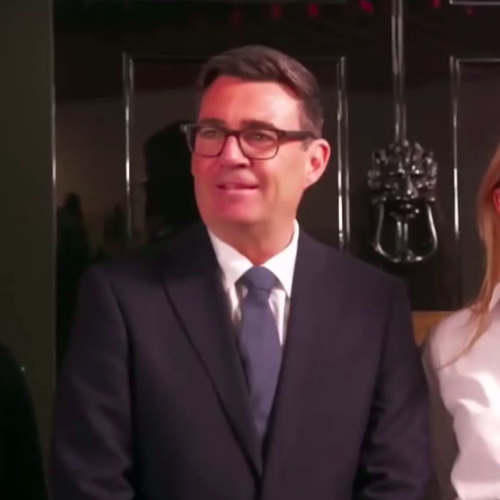
Burnham was also promoted by what many consider to be the right-leaning press. In June 2023, Labour MPs wooed “the King of the North” to return to Parliament, according to the Daily Mail. The Mail recounted comments that Burnham had “character, passion and likeability,” and said that Burnham had earned his “nickname after standing up to the Government over planned pandemic measures.” The Mail also noted that Burnham described Westminster as a “living nightmare” and “basically dysfunctional.”
In September 2025, The Telegraph published a startling propaganda piece for Burnham. Though the article contained some spoken criticisms of Burnham, its overall tenor was to present him as “the King of the North,” a maverick political heavyweight ready to burst the Westminster bubble. Just as it has been throughout his time as GMCA mayor, when pressed, Burnham’s ambition to take the top job was transparent. Telegraph Journalist John Driver asked him if he wanted to be prime minister, and Burnham replied:
I stood twice to be leader of the Labour Party. [. . .] And I think that tells you, doesn’t it?
As his moment approached, the propaganda kicked into overdrive. In May 2026, writing for The Telegraph, journalist and editor Eleanor Mills declared that Burnham had the “Right Stuff” to be prime minister. Mills told of her long friendship with Burnham. She outlined how he had “grown as a man and a politician,” that he “knows which levers to pull in Westminster and beyond,” that he is “his own man,” and is ready “to make the hard choices.”
With Burnham striding confidently towards Downing Street, people like Culture Secretary Lisa Nandy were enthusiastically peddling Burnham’s fabricated King of the North mythology:
In the North of England we remember very much that at the moment when we were most struggling during the pandemic, when the Tory government refused to properly compensate us for that and to treat us fairly like other parts of the country, that he [Burnham] went out and fought for us. And I think that is the sort of politician that we need in these times.
Starting in the summer of 2026, the MSM, and the BBC in particular, began a Burnham propaganda onslaught. The BBC combined interviews, analysis, on-the-ground reports, and opinion pieces with an online “viral clips” campaign to broaden the King of the North’s national appeal.
The Austrian-based eMedia Monitor (eMM) conducted analysis of more than 53,000 Burnham-related media pieces, across TV, radio, web TV and podcasts, between January 2026 and June 2026—the Makerfield by election. The eMM found:
Across the monitored period, Burnham’s broadcast presence was both significant and sustained. It was notable not only in volume but in consistency of messaging and topics covered. Broadcast media focused primarily on the political drama of the story over policy-related matters. [. . .] [M]edia interest shifted at critical moments in the pre-election period. [. . .] Burnham’s media profile was sustained by message consistency, regional identity and national political relevance.
It is worth again highlighting that Burnham has never “won” the support of any constituency of citizens, certainly not in the GMCA region. He is primarily a media personality who has clearly been moulded into the top political job in the UK by the influential forces backing him and his Manchesterism agenda.
With the image of Burnham as the King of the North firmly planted in the minds of people across the country, having swanned into Westminster on 20th July 2026, Burnham has been placed in the right place, at the right time, to deliver what is required of him: Manchesterism.
As we discussed in Part 1, the modern form of Manchesterism is not Burnham’s idea, but Burnham is its most prominent UK flag bearer. Modern Manchesterism is the antithesis of the original Manchesterism. As noted by Max Skjönsberg, an Associate Professor of Humanities at the University of Florida, Manchesterism was the name given to “the political platform behind the Anti-Corn Law League, England’s radical free-traders in the 19th century.”
In 1815, the first of the Corn Laws introduced a raft of protectionist price-setting regulations and tariffs on agricultural products. They essentially assured wealthy landowners profits at the expense of higher food prices—the cost of living crisis of its day. At the same time, the industrial revolution increasingly shifted the economic power base to a new class of wealthy industrialists and saw the rapid growth of a large urban workforce that needed to eat.
In 1835, influenced by the socioeconomic ideas flowing from the Manchester School led by Richard Cobden and John Bright, the national Anti-Corn Law League formed in Manchester. The League sought to repeal the Corn Laws and stimulate free trade. Though the motivation of the industrialists behind the League was to reduce wage pressures, the campaign to repeal the Corn Laws was widely perceived as a class struggle. The Corn Laws were eventually scrapped in 1846.
A few years earlier, in 1842, firebrand preacher, the Rev. J. W. Massie, gave a rousing address at the Manchester Corn Exchange that captured the mood of the movement that brought the Corn Laws down:
So perish all the laws that would interfere with the food of the people!’ Such a law ‘starves the honest children of industry to gratify the luxurious cravings of a heartless and pampered oligarchy.
Rhetorically then, Manchesterism was opposed to oligarchy. Conversely, the modern model of Manchesterism, championed by Burnham, serves and further empowers the technocratic oligarchs of today. In this sense, and many others, Burnham’s Manchesterism is the opposite of 19th-century Manchesterism.
We’ll discuss Manchesterism in some depth in Part 3, but, before we do, it is worth briefly outlining what a massive sham Burnham’s Manchesterism is. Andy Burnham is using his free and unfettered access to the MSM to sell Manchesterism, so we may as well listen to what he says it is:
The four horsemen of Britain’s apocalypse [broken Britain] are deindustrialisation, privatisation, austerity and Brexit. [. . .] [N]ow is the moment in this parliament to make a clearer case about exactly who broke Britain and lay out bolder fixes. We hope what has been happening in Manchester might offer inspiration.
Over the past decade, we have become more and more functional as the country has become dysfunctional. We have used devolution to build a new, more collaborative political culture that is the polar opposite of the Westminster and Whitehall world. [. . .] We have been growing at double the rate of the UK average and this week set out plans to reindustrialise our city region. [. . .]
[B]y supporting more of our residents to access opportunity in what is the fastest-growing city-region economy in the UK, we are showing that it is possible to make more effective use of public funds. [. . .] “Manchesterism” is a modern and functional response to the high-inequality, low-growth trap. [. . .] It is about creating a new politics to plot our way out of that and develop a new economy.
Sounds fantastic, doesn’t it?
Economic growth driven by the intelligent use of public funds to reindustrialise—in the modern technological sense—and to defeat rampant privatisation, austerity, and rebalance the UK economy in a post-Brexit world. Public investment in devolved, autonomous city-regions provides the key to this wonderful reinvigoration of regional functional economies. The people will have more opportunities, fueled by perpetual growth: a new politics for a new economy.
Except it’s not true!
For a start, oligarchy is more than 2000 years old, and feudalism more than 1000. So Burnham’s Manchesterism—the feudal rule of an oligarchy—is hardly new politics.
The so-called growth brought about by Manchesterism, supposedly across the GMCA “city-region,” is almost exclusively confined to the city centre. Despite the fact that this economic miracle story has been promoted by the BBC and other MSM outlets, nearly all of that growth is based upon the “expansion of knowledge-intensive and tradeable services.” That is to say, the city of Manchester has become home to a technological service industry providing a few white-collar jobs for people supporting productivity somewhere else. These are jobs that will probably be replaced by AI in the near future. They will almost certainly be replaced by AI if Burnham’s plans for the digital transformation of the UK succeed—see Part 3.
Outside of the city centre, like nearly everywhere else in the UK, gross disposable income in the GMCA city region has fallen. The 5.6% drop, between 1997 and 2024, in the GMCA “city region” is, however, worse than the national average. Most of this increasing hardship is attributable to Burnham’s impoverishment plan that he and his team have evidently hatched to bolster the profits of private sector oligarchs. This is sometimes called “The Productive State” model, or more commonly Manchesterism, but “extortion” seems the most appropriate term.
During his nine-year tenure of the GMCA, Andy Burnham borrowed so heavily from private investors and private institutional bondholders that he increased the GMCA’s public debt by 65% in just the first two years of his mayorship. Burnham spent £550K just on painting yellow Manchester’s “publicly controlled” Bee Network buses.
By 2019 Burnham had taken a GMCA public debt—to the private sector—from £964 million to £1.56 billion. Faced with ridiculous finances, Burnham’s solution was to increase council tax by 127% and effectively saddle every GMCA resident with an additional £462 of debt. Despite trying to recoup the money he’d borrowed by taxing the public, after nine years, Burnham’s Manchesterism still left the GMCA £1.34 billion in debt. All of it is repayable plus interest, ultimately, to oligarchs.
In short, Andy Burnham’s Manchesterism transferred more than half a billion pounds of wealth from the people of the GMCA “city region” to private sector investors, in return for which the vast majority of the city region’s citizenry saw their economic opportunities reduce. It is difficult to see how this scheme constitutes much more than theft. As prime minister, Burnham is now the First Lord of the Treasury, and he has made Manchesterism a centre-piece of his premiership.
But Manchesterism gets worse. Much worse.
And the true objective of Prime Minister Andy Burnham’s Manchesterism is what we’ll discuss in Part 3.




 Please feel free to share anything from iaindavis[.]com excluding any and all third party content. I use a Creative Commons License. All I ask is that you give credit to the author and clearly mark any changes you make. Please share my work widely. Censorship is increasing and we need to get this information out there. If you value what I do then please consider supporting my work. Many thanks.
Please consider supporting my work. I really need your help if I am going to continue to provide the research and analysis that you value on a full-time basis. You can support my work for less than the price of a cup of coffee via my donor page or alternative become a paid subscriber to my Substack.
AI Transparency: I do not use AI to research or write any of my work. I use an AI grammar tool to check the first draft of the completed article because I can’t spell and my grammar is atrocious.
Please feel free to share anything from iaindavis[.]com excluding any and all third party content. I use a Creative Commons License. All I ask is that you give credit to the author and clearly mark any changes you make. Please share my work widely. Censorship is increasing and we need to get this information out there. If you value what I do then please consider supporting my work. Many thanks.
Please consider supporting my work. I really need your help if I am going to continue to provide the research and analysis that you value on a full-time basis. You can support my work for less than the price of a cup of coffee via my donor page or alternative become a paid subscriber to my Substack.
AI Transparency: I do not use AI to research or write any of my work. I use an AI grammar tool to check the first draft of the completed article because I can’t spell and my grammar is atrocious.

Be the first to comment on "Andy Burnham’s Trojan Manchesterism – Part 2"