Also available on Substack.
* * *
In Part 1, we considered the network of political operators that have worked to ensure Andy Burnham became UK Prime Minister. In Part 2 we examined the media network that has propagandised the nation, creating a Burnham mythology to provide faux-legitimisation for his premiership in the absence of any political mandate.
These UK-based political and propaganda networks are themselves representative of a much larger public-private global network. Andy Burnham has evidently been inserted into the top political job by the UK public-private network in order to digitally transform the UK at the behest of global interests.
On 31st August 2026, independent journalist and former UK Column reporter Ben Rubin produced an investigative segment discussing the topic of Manchesterism. Rubin reported that Manchesterism is, in part, a product of seven devolution deals that span from 2009 to 2017. Conservative, Coalition, and Labour governments have steadily formed the structural, legislative, and regulatory condition for Manchesterism over the years.
As Rubin highlights, however, the UK-based network that has pushed Manchesterism is part of the wider public-private network we’ve just mentioned. Rubin accurately described Manchesterism as a project of “unelected state operatives and highly remunerated consultants working for a transnational capitalist [. . .] predator class”—oligarchs.
Andy Burnham, then, is a front man and a policy enforcer for an imminent UK Technocracy. Burnham does not represent the UK’s interests, nor those of the UK population. Ultimately, Burnham represents the global oligarch-led network trying to install a worldwide Technocracy.
Another, among the groups Burnham does represent, is the Fabian Society. Drawing its inspiration from the tactics of the Roman general Quintus Fabius, the Fabian Society’s ethos is that “when the time comes, you must strike hard.” Burnham’s time has arrived.
With a history rooted in eugenics and population reduction, the Fabian society was extremely influential in the creation of the Labour Party. Every Labour prime minister has been a Fabian, and Burnham is no exception.
While he was mayor of the Greater Manchester Combined Authority (GMCA), in October 2023 Burnham spoke to Kate Murray, the Fabian’s editorial director, about the allegedly devolved future of the UK and, specifically, England. Maintaining the “King of the North” mythos, Murray and the Fabians presented Burnham as a “local hero.”
Burnham told Murray:
[T]he 21st century is going to be more about change driven by cities and city regions – bottom-up change. The kind of thinking that says everything has to be controlled and legislated for I don’t think ever particularly worked but it really won’t work in the 21st century. England, and I would say the rest of the UK, is crying out for deeper devolution. [. . .] I think this phase of my political journey is best served in establishing a new tier of governance for England.
Contrary to Burnham’s assertions, certainly in England, there is no public appetite for “deeper devolution” of the kind offered by the British political establishment. As noted in Part 2, when the English have been asked, they have not shown any enthusiasm for the devolution packages persistently foisted on them by various national governments. The state’s response has been to ignore the will of the people and to stop asking the question.
Take another example: in May 1997, less than 25% of eligible voters wanted a devolved Greater London Authority, but it was created regardless. The overwhelming lack of public interest has been reaffirmed in every subsequent London mayoral election.
In May 2024, current London Mayor Sadiq Khan “won” 43.8% of the vote from a 40.5% turnout. Just 17.7% of Londoners want Sadiq Khan to be their mayor, 82.3% of Londoners do not, and the vast majority either want no mayor at all or are completely disinterested. Khan does not represent Londoners.
The former chair of the Fabian Society (2008 – 2010), Khan is the current global chair of the C40 Cities network. Sadiq Khan represents the C40 Cities network.
C40 is a global public-private partnership (G3P) that seeks to transform cities to meet United Nations (UN) global governance goals by empowering a network of mayors that “shapes urban policy” on behalf of the G3P controlling C40 Cities; it is a globalist think tank extraneous to national governments.
C40’s overseeing G3P network consists of Bloomberg Philanthropies (the Bloomberg family), the Global Environment Facility (the Rothschild family), the Open Society Foundation (the Soros family), the Rockefeller family, the UN, the EU, numerous multinational corporations, and elements within the UK and Danish governments, among others.

Burnham’s claim that Manchesterism—city-state governance—is somehow sociopolitical change driven from “bottom-up” is drivel. Over the last few decades, Tory, Labour, and Coalition governments have relentlessly promoted and tried to install devolution packages. The English people, who have repeatedly rejected the proposed changes, have had no influence over the policy trajectory whatsoever.
The reason for this situation is straightforward: the English live in a functional oligarchy, and governments—and politicians like Burnham—serve that oligarchy.
Plainly, it makes no difference which political party is supposedly leading the country. As highlighted by Burnham and the Fabians in 2023, the English are going to have a “new tier of governance” delivered through a network of “cities and city regions” whether they want that new model of governance or not. Mayors, such as London’s Sadiq Khan, have already been embedded to meet that agenda.
The latest step along the march toward so-called devolution is the Labour government’s English Devolution and Community Empowerment Act 2026 (EDCE Act), which received Royal Assent in April 2026—before Burnham was inserted into Downing Street to implement it. Needless to say, “community empowerment” is anathema to the effect of the Act.
Contrary to the common comprehension of “devolution,” as independent researcher and journalist Escapekey rightly observed, the EDCE Act centralises authority. The “new tier of governance” manifests as the “strategic authority,” which “sits between the central government’s objectives and the population, applying conditions defined above to the community below. [The strategic authority] does not have the power to contest what’s requested of it—it simply has to apply the standard determined above.”
Under the EDCE Act, the construction of the new governance tier, masquerading as devolution, affords the Secretary of State, from whatever political party, the power to define, for example, the “general health determinants” that the supposedly devolved city-state must incorporate into their policies.
Escapekey notes:
Section 45 [of the EDCE Act] is where the architecture reveals itself. [. . .] Everything is a health determinant. Which means every decision made by every combined authority — about housing, transport, planning, economic development, the environment — must be evaluated against health outcomes.
I have written extensively about this “decentralisation to recentralisation trick.” Decentralisation, in this case “devolution,” is presented as a solution to the inefficiency of national government procurement, planning, and provision. Such devolution is an illusion. The new tier of governance—the strategic authority—is created to insert centralised authority into every supposedly local policy decision.
Call it Manchesterism, call it decentralisation, or devolution, call it whatever, the “decentralisation to recentralisation trick” is a strategy planned at the global governance level. For the oligarch architects of global governance, Manchesterism—the UK branding of their city-state agenda—is their preferred route to exerting Technocratic control. In this instance, it is over the English.
We can clearly define what Manchesterism is actually designed to deliver. Manchesterism is ostensibly comprised of two components. The first is digital transformation, and the second is usury.
The BBC, of course, hailed Burnham’s 2017 mayoral election victory, framing it as historic and highlighting that 63% of voters elected him—though it conceded that less than 29% bothered to vote. Burnham preposterously spun the fringe minority support he had gleaned from an overwhelmingly indifferent GMCA electorate as “a big mandate.” He promised that the GMCA, under his leadership, would “take control” of some sort of “new politics.”
It soon became clear exactly what kind of “new politics” Burnham had in mind. In May 2017, one of his first acts as mayor was to launch the GMCA’s Digital City Initiative (DCI). Promising to make Greater Manchester “a digital city with a difference,” and claiming that Greater Manchester was “on the digital frontier,” Burnham outlined his hopes for the emerging city-state:
We want to fuse technological advancement with culture, ethics, communities and places to build a world which is connected, creative and cooperative, and a modern and prosperous Greater Manchester where no-one is left behind. [. . .] I don’t want Greater Manchester to be just a smart city, I want it to be the smartest city.
Digital transformation, and the requisite private sector investment in “frontier technology,” is a key component of the global governance project, expressed in the UK as Manchesterism. Burnham is the UK’s PR front man for a global governance agenda.
The United Nations (UN)—an oligarch-led public-private initiative—aims to roll out “frontier technology” in the “digital frontier.” The UN defines frontier technology as:
[A]rtificial intelligence and machine learning, renewable energy technologies, energy storage technologies, electric and autonomous vehicles and drones, genetic engineering, as well as cryptocurrencies and blockchains.
Burnham’s DCI “plan” complied fully with the UN’s New Urban Agenda (UN-NUA), which was officially launched in December 2016, just before Burnham supposedly took “control” of a new model of frontier politics in the GMCA region. The UN-NUA seeks to use “frontier technology” to accelerate adoption of Sustainable Development Goals (SDGs), especially SDG 11, to make “cities and human settlements inclusive, safe, resilient, and sustainable.” The so-called 15-minute city, for instance, is an SDG 11 initiative.
To appreciate where Burnham’s Manchesterism-aligned Digital City Initiative (DCI) actually originated, we only need to look at the scale of the G3P network behind what we call Manchesterism as described by the UN:
Member States; intergovernmental organizations; the United Nations Human Settlements Programme (UN-Habitat) plus more than 40 United Nations agencies, funds, and programmes; 200 Policy Unit experts with 20 co-leading organizations; 16 partner constituent groups of the General Assembly of Partners; thousands of subnational and local governments and all major networks of local and regional governments coordinated by the Global Taskforce of Local and Regional Governments; 197 participating states; over 1,100 organizations; and more than 58,000 networks were involved in the preparations of the New Urban Agenda.
You may ask what this network’s agenda is trying to achieve. The short answer is the centralised global behavioural control of the population.
The UN-NUA calls for “technology and communication networks to be strengthened” and to expand “the capacity of local governments to effectively procure, test and implement frontier technologies.” The UN is eager to role out frontier technology through a network of smart cities because the digital surveillance systems—especially combined with AI, digital identity and programmable digital currencies—can be used by oligarchs, ultimately, to control human decision making and behaviour.
As researchers writing for the Indonesian Journal of Information Systems and Informatics noted:
The influence of smart-city technology on consumer behavior in urban environments and people’s daily routines and lifestyle habits is significant. [. . .] Thus, the application of smart-city technology not only transforms city infrastructure and services, but also brings significant changes in citizen behavior.
It is much easier to enforce global policy diktats on people if they are technologically denied the ability to do anything but follow the policy. Therefore, in the hope of compelling humanity to obey global governance, the oligarch network that operates through the UN asked itself how it could best use technology to stamp its distant global authority on populations—technological slavery. The answer it came up with is the “digital transformation” across a network of city-states, and that is what Burnham is tasked with delivering in England and, doubtless, the UK.
To explain: in 2013, American political theorist Benjamin R. Barber (1939–2017) published If Mayors Ruled the World: Dysfunctional Nations, Rising Cities. Barber argued that city administrations were unencumbered by political divisions and national rivalries and were, therefore, better “building blocks of global governance.”
Advocating a global network of cities, Barber wrote:
Envision not states but cities as building blocks for global governance. [. . .] Global governance in which the city predominates is the aim.
This idea was immediately picked up and pursued by the UN and its partners. Directly influenced by Barber’s ideas, the billionnaire Michael Bloomberg established his first CityLab summit in 2013. In 2014, Bloomberg was appointed as the UN’s inaugural Special Envoy for Cities and Climate Change.
According to then UN Secretary General Ban Ki-moon, Bloomberg’s mission was to consult “with mayors and related key stakeholders” in order to “mobilize action among cities as part of [the UN’s] long-term strategy.” As president of the board of the C40 Cities network, Bloomberg soon convened the Global Compact of Mayors, committing networked city leaders to implement UN sustainability policies.
In 2016, the UN’s Global Compact of Mayors joined with the similar European Union (EU) Covenant of Mayors to become the Global Covenant of Mayors for Climate and Energy (GCoM). The GCoM established the Invest4Cities initiative to generate “massive and targeted investment” to construct smart cities. The private sector’s opportunity offered oligarchs and other financiers “$23 trillion in investment potential” by 2030.
The public sector’s role—national and local government—is to create “the enabling environments that support local investment.” In the name of Sustainable Development, the GCoM plan is that “large-scale financing instruments” will fund “local implementation” of frontier technologies to construct global governance-compliant smart cities.
In the same year (2016), Michael Bloomberg created the Global Parliament of Mayors (GPM) to give the selected civic leaders—not national government representatives—formal global governance roles. The GPM asserts “the city’s right to self-government” and promotes “collective city decision-making across national borders.” The GPM is also “actively engaged in decision-making by international organisations.”
The GPM openly declares its objectives:
To establish a new global governance platform empowering mayors to deliver viable cross-border solutions to global challenges. [. . .] The Global Parliament of Mayors is an unprecedented new experiment in democratic global governance platform by, for, and of cities. [. . .] In this era of interdependence, where nation states are increasingly dysfunctional and cities are everywhere rising, the moment has come for cities to take the leap from effective local governance to true global governance.
The GPM is the UN’s expression of Barber’s vision of “global governance in which the city predominates.”
The purpose, then, of the GPM is to undermine the supposed political sovereignty of national governments and reimagine international relations through a global network of smart city-states—per the oligarch’s wishes. Manchester City Council Leaders Richard Leese—who shocked Burnham in 2020, live on national television (see Part 2)—and Andy Burnham are both contributing members of the GPM. Presumably, Burnham is committed to GPM principles and is seeking to destroy the UK from within in order to achieve global governance goals. He’s not alone, of course.
In 2017, adopting accelerationist principles, the C40 network started implementing a number of “High-Impact Accelerators.” The C40 accelerators form one of the “project pipelines” that contribute to the GCoM’s Invest4Cities strategy.
Invest4Cities aims to “accelerate city and local government access to financial resources” by “unlocking large-scale financing instruments to boost urban action implementation.” As you can imagine, with $23 trillion of global investment opportunities in sight, the envisaged ROI is a mouthwatering prospect for any oligarch.
In 2018, to expedite progress, Burnham signed the people of the GMCA up to the C40 Cities Fossil Fuel Free Streets Declaration, promising to report progress back to the transnational capitalist billionaires behind the C40 Cities initiative. Burnham agreed with the oligarchs that he should “transform the way people travel” around the GMCA region through behavioural change policies to shift them from private car ownership to “walking, cycling and the use of public and shared transport.”
In 2019, with the support of mayors like Burnham, C40 Cities published a report in which it outlined how our behaviour should be changed:
- Meat and dairy consumption will be banned;
- Daily caloric intake will be set at 2,500 kcal or less;
- Allowable plant-based food will come from “sustainable” multinational corporate mega-farms;
- Private vehicle ownership will be outlawed;
- Flights will be restricted to one short-haul return flight per year;
- No more than three new items of clothing shall be bought by each person annually.
According to C40 Cities, consumption of everything, from water to energy, from raw materials to manufactured products, will be monitored, restricted, controlled, and allocated as deemed necessary—Technocracy. Thus, our behaviour will be transformed. C40’s 2019 report provides us with a clear indication of where “global governance in which the city predominates” is intended to take us and where Prime Minister Burnham will lead us if we follow.
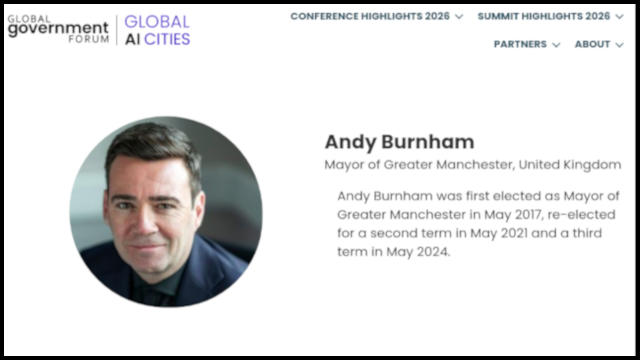
While GMCA mayor, Andy Burnham was a valued contributor to the Global Government Forum (GGF). Shortly before becoming prime minister, on behalf of the GCF, Burnham convened the Global AI Cities summit in Manchester.
Global AI Cities is another networking opportunity for public and private “partners” to build cities with AI, transform cities, and engineer how “cities respond to rapid economic and societal change” through the extensive use of AI. The Global AI Cities’ stated purpose is “to accelerate the transformation of local services and support the development of digitally-enabled cities around the world.” That is, to deliver the UN’s New Urban Agenda by weaponising frontier technology to restrict our behaviour.
The GCF is backed by the US tech giant Accenture, which is a founding member of the ID2020 alliance. ID2020 is a global “public/private partnership committed to providing a digital identity”—SDG 16.9. Digital ID (interoperable digital identity) is a tool for censorship and oppression designed to bind us to global governance decrees.
Consequently, now that he has been placed in Downing Street, Burnham is the figurehead for a raft of proposed government online censorship regulations that will inevitably lead to a widespread requirement to use digital ID to access the internet. Evidently, the objective is to coerce as many people as possible to adopt digital ID. Adoption of digital ID is what the G3P network, which Burnham represents, desires.
As part of the propaganda tsunami that preceeded Burnham’s installation as prime minister, Bloomberg ran articles in early 2026 extoling the claimed virtues of both Manchesterism and Burnham. Confirming a point we discussed in Part 2, Bloomberg’s listed signs of purported economic growth—across a region of more than 2.2 million people—were all highly localised in Manchester’s city centre: “The city center’s population is approaching 100,000 – up from hundreds in 1990, [. . .] the number of skyscrapers has increased sevenfold, [. . .] [f]ormer industrial districts [are] filled with apartments, joggers and bakeries.”
Bloomberg noted the comments of “Jim O’Neill, the former Treasury minister and Goldman Sachs chief economist,” who fully supports the removal of productivity and gentrification that typifies Manchesterism. As prime minister, Burmham has appointed an economic advisory team led by Jim O’Neill, Andy Haldane (former Bank of England), and Richard Hughes (former Office of Budget Responsibility – OBR) to roll out the same Manchesterism model nationally.
In the interview with Bloomberg, O’Neill highlighted that Manchester had “attracted the highest foreign direct investment outside the capital.” Again, not surprising, because Manchesterism offers oligarchs immense profit potential.
The stated “Framework for Manchesterism” is “The Productive State.” Both of the authors, Matthew Lawrence and Alex Williams, work for Common Wealth—a progressive policy think tank. Common Wealth receives oligarch funding from, among others, the Omidyar Network (the Omidyar family), the Open Society Foundation, and Rockefeller Philanthropies. It is essentially supported by the same oligarch network that backs C40 Cities, the GCoM, and the GPM, and commands the UN.
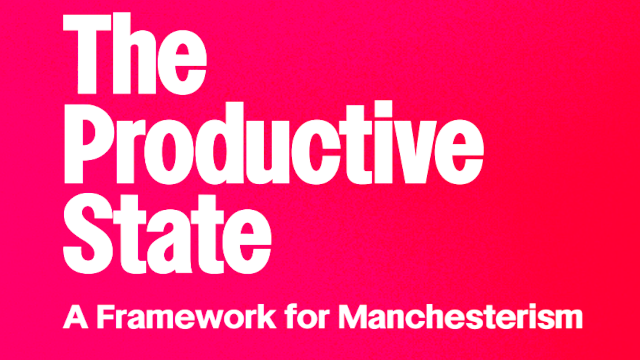
The plan, outlined in The Productive State, sounds enticing at first. “Public corporations”—operating “at city-region scale”—will “own” and run essential public services and utilities while adopting a long-term investment strategy. This will supposedly lower public costs, control prices, and, it is claimed, dissociate crucial service industries, such as public transport, water, and energy, from shareholder profits. Regrettably, The Productive State is highly misleading.
According to Lawrence and Williams:
The destination is an economic system with three distinct tiers, each governed by different principles. At the foundation sits decommodified provision of essentials [public services and utilities]. Above the foundation sits a stabilised market economy where private production thrives but where the state intervenes as market participant or public producer to prevent instability and check rent extraction. [. . .]
At the apex sits the innovation frontier — sectors characterised by rapid technological change and radical uncertainty — remaining primarily private because change is too fast for effective planning, but supported by ambitious industrial strategy. This tier operates atop the enabling foundation. Entrepreneurs can take genuine risks because failure does not mean destitution. Workers can move between jobs and cities because the essentials are portable and guaranteed. Each tier depends on the one below, the frontier enabled by the foundation.
Forget about job security. “Workers”—those who still have jobs—serve as a mobile resource, ready to be relocated “between jobs and cities” as needed.
The Framework for Manchesterism supposedly decommodifies [removes the shareholder profit incentive] from public services and utilities. The “distinct tiers” of the new Manchesterism-based economy are:
- The decommodified foundation—energy, water, housing, care, transport—will be “owned” by national “public corporations” and “city-region authorities.”
- The stabilised market middle—manufacturing, retail, most services, consumer goods—will primarily be deliverd by the private sector but the public sector will step in when the private sector isn’t interested.
Together, the decommodified foundation and the stabalised market “enable” the “security” allegedly required by:
- The innovation frontier—AI, biotech, advanced manufacturing, new energy technologies—which will also be delivered by the private sector. “Adaptive regulation” and taxpayers’ investment in their for-profit R&D will provide the selected “entrepreneurs” with the leeway they need.
The Productive State further defines the so-called functions of Manchesterism.
In the “dealer function” the taxpayer invests in public service delivery, utilities, and infrastructure over the long term to reduce market volatility and stabalise prices—in theory. That is to say, public “ownership” in Manchesterism means the creation of a public sector subsidised market, ultimately for the benefit of the private sector “innovation frontier.”
In “the producer function” the private sector enters the public sector’s “stabalised market middle.” Private corporations won’t hoover up all the best contracts and avoid the unprofitable ones like the plague because reasons. Or, as Lawrence and Williams imagine, because the public sector producers, through some mysterious device, change “the terms on which the private market operates.”
Presumably land, bricks, fuels, pharmaceuticals, agri-chemicals, raw materials and all the other necessary goods and services, etc.—all provided by the private sector to the taxpayer-funded public sector—will be priced to reflect some sort of good-will discount.
These Manchesterism functions will lead to decommodification, making initiatives like “a national energy guarantee” possible. The guarantee will magically provide “a free block of electricity and gas” that could “cover around 80 per cent of typical household energy consumption at zero cost.” Manchesterism will make global energy markets disappear overnight. Energy will be free!
[I promise you, I am not just winding you up.]
Andy Burnham certainly understands that the suggestion of free energy is ludicrous. In response to fuel prices deepening the cost of living woes for British people, Burnham said:
The reality is that global events are pushing up costs.
Burnham seems to grasp that global market events largely shape prices internationally. Lawrence and Williams apparently do not share this awareness, and Manchesterism seemingly does not acknowledge how the global economy functions.
Faced with this realisation, Burnham’s prime-ministerial solution, however, is that we should use “Google Maps” to locate the best deals. Great news for the UK government’s partner Google, but tantamount to meaningless for the rest of us.
As prime minister, it is supposedly within Burnham’s power to try to lower the huge tax levies his government places on fuels, or he could rescind his decision to allow the US government to continue its illegal war against Iran from UK air bases, given that the alleged “war” is the cause of the price hikes. Instead, he suggests we Google it.
Moving back to The Productive State, you may have spotted some of the many other flaws in the Framework for Manchesterism. How will the British political state independently lower all of these costs? We are assured that this can be done through the combined wizardry of “decommodification” and the “stabilised market middle.”
The “Productive State is pro-enterprise” and “lowers risks” for investors in the whole “stabilised market” economy—or “foundation.” The “public corporation”—through which taxpayers supposedly “own” essential infrastructure and service industries don’t forget—will “borrow in its own name.” Of course, the public corporation is not going to borrow anything; we are.
Don’t worry, the borrowing will be “self-financing through higher GDP and tax receipts”—increased taxes. We’ll get to higher GDP bit in a moment.
The devolved Utopia will blossom thanks to a powerful enchantment:
The public corporation can invest [by raising taxes and borrowing] in Britain’s foundational infrastructure at lower cost because [Manchesterism] reduces the debt risk premium that private finance faces. The economic cost of risk reallocated: risks borne by private investors in market models are instead absorbed by the public sector balance sheet, and ultimately by taxpayers or users, but at a lower cost overall.
So, Manchesterism places the burden of financial “risk” on the public. This “lower risk”—covered by you and me—will entice oligarchs to invest in devolved smart city-state infrastructure, not because they want to make returns on a “$23 trillion in investment potential,” nor because they want to lock us all down with frontier technology, but because it is just such a sound long-term investment strategy that serves the public good.
This means that the “innovation frontier” or “apex” of Manchesterism—a functional layer “characterised by rapid technological change and radical uncertainty”—is where the private sector oligarchs will be subsidised to innovate—install frontier technology across a network of smart city-states.
The Productive State proposes:
As technologies mature from frontier to infrastructure, they move [down] through the tiers: from experiment to stabilised market to, eventually, decommodified public good.
Essentially, what Manchesterism proposes is that investors in the “innovation frontier” force the “rapid technological change” upon smart city-state populations, while the same populations provide the public sector market for the mature technology’s eventual sale and oligarch ROI profits. The taxpayers will protect “entrepreneurs” against potential losses from the “radical uncertainty” inherent to the entrepreneurs’ technosocial experimentation.
The claimed GDP growth will materialise through “a generation of transformative megaprojects” that will result from building “essential infrastructure at speed, scale, and costeffectiveness.” This will be funded by tax rises and public borrowing. This is how Burnham transfered more than half a billion pounds from the public sector to the private sector—for no discernible benefit to the GMCA majority—in less than a decade.
Once the frontier technology has “matured,” overburdened taxpayers will be forced to borrow even more from the private sector to finance their own technological enslavement. As the oligarchs’ investment risk will be covered by the taxpayer, and since the market for their digital products and services is hardwired into the Manchesterism model, “failure does not mean destitution” for the wealthiest people on the planet.
In short, Manchesterism is the creation of an enabling environment for oligarch investors to construct their digital global governance infrastructure in England. Or, in the deceptive rhetoric of the UN-NUA, generate “the enabling environments that support local investment.”
From the taxpayers’ perspective, Manchesterism is evidently usury leading to penury. In terms of the intended AI-driven digital transformation, Manchesterism is Technocracy—behavioural control through the allocation and distribution of resources—leading to enslavement.
As we noted in Part 1, Manchesterism has also been promoted by academia, especially the University of Manchester (UoM). The UoM is home to the Productivity Lab, which is a core research hub for the Productivity Institute academic network.
The Productivity Institute refers to Manchesterism as the Manchester model and notes that the economic growth, which clearly only benefits a select few, is not sustained by political leadership alone. The Manchester model of growth relies on “institutional architecture” and “policy coordination,” no matter which political party or politician is supposedly leading.
Observing that the Manchester model was “international all along,” and echoing UN-NUA calls to harness “massive and targeted investment” to install the necessary frontier technology to achieve “global governance in which the city predominates,” the Productivity Institute reports:
[Manchester] connected local capabilities to global capital. The city-region attracted [. . .] $13.7 billion between 2013 and 2025 [. . .], much of it channelled into the digital, scientific and professional sectors that drove its productivity growth. [. . .] A domestic growth strategy cannot be separated from an international one. [. . .] Manchester’s experience offers the method. Identify the capabilities of a place, invest in the institutions that support them, and connect them deliberately to international capital, knowledge and markets. The opportunity now is to apply that method at national scale – connecting the UK’s domestic growth ambitions to the international relationships on which their success depends.
The Productive State—Manchesterism—is seemingly founded on the premise that the UK can have a growth strategy somehow disconnected from global economic and particularly international monetary forces. Setting aside that contradiction, the Productivity Institute, which strongly argues for the UK rejoining the EU, has hit the nail on the head in many respects.
The point of Manchesterism is to connect “local capabilities to global capital.” The new Burnham government aims to transform England and the rest of the UK into an extension of “international capital, knowledge, and markets”—the UN-NUA.
Global capital is controlled by a global functional oligarchy. Consequently, Burnham is poised to deliver, in the UK, what the oligarchs want: “global governance in which the city predominates.”
You do not have to take my word for any of these claims. In March 2026, a few months before he became prime minister, Andy Burnham gave an interview to the CEO of Informed Solution, Elizabeth Vega. During that discussion, Burnham said:
I see digital tech AI and all of its forms playing a foundational role in the ongoing success of Greater Manchester, underpinning everything. [. . .] I set the ambition of making Greater Manchester the UK’s leading digital city region. [. . .] It’s about all of our residents, all citizens online, everybody connected to the digital economy.
Burnham effectively pronounced that he has implemented the UN-NUA agenda in the emerging GMCA smart city-state. He added that the GMCA’s “innovation frontier,” defined in The Productive State, works closely with the intelligence agencies:
GCHQ have made a commitment to Greater Manchester around innovation. [. . .] It’s important to have a strategic vision and digital and AI intersect with pretty much every of the key sectors that the Greater Manchester has. Creative, manufacturing, advanced materials, everything. [. . .] [AI] will underpin all of the other innovative industries that we’ve got. Life sciences and health, obviously.

As we move towards national “devolution,” Burnham conceded that the “strategic authority,” or the “new tier of governance,” will use health determinants—“obviously”—to coordinate policy across the entire GMCA smart city-state.
The “General Health Determinants,” outlined in Section 45 of the EDCE Act, are:
(a) standards of housing, transport services or public safety,
(b) environmental factors, including air quality and access to green space and bodies of water,
(c) employment prospects, earning capacity and any other matters that affect levels of prosperity,
(d) the degree of ease or difficulty with which persons have access to public services,
(e) the use, or level of use, of tobacco, alcohol or other substances, and any other matters of personal behaviour or lifestyle, that are or may be harmful to health,
and any other matters that are determinants of life expectancy or the state of health of persons generally, other than genetic or biological factors.
“Any other matters of personal behaviour or lifestyle” and any other declared determinants of “the state of health” gives the new tier of governance control over the “behaviour” of “persons generally.” As Burnham stresses, “everything” will be monitored and surveilled, through the deployment of smart city frontier technology, overseen by and coordinated through the system-wide use of AI.
Burnham went on:
We want to bring forward an AI demonstrator. So bring together public data sets from local, regional, national level and start to use AI to identify people within the city region who need a different approach.
“Data sets” will be gathered, analysed, and AI will “identify people” and single them out for “a different approach.” The UN-NUA agenda is specifically designed to enable the precise targeting of idividuals for “a different approach.” Placing an almost unimaginable degree of behavioural control in the hands of oligarchs is the primary objective of the UN-NUA.
AI is not just some tool enabling the remote, logical automation of administrative systems. It is being used as the “foundation” of a programmable global governance system that can be and is being programmed by people with very specific agendas.
Burnham was only prepared to talk to Vega about using AI to take “a different approach” to health interventions and targeted welfare support for identified individuals. Yet elsewhere in the conversation, he openly discusses “everybody” being “connected” to “every” aspect of the new tier of governance. Evidently, a punitive “different approach” is also a core feature of the envisaged Manchesterism.
Bear in mind that, for some time, the global public-private partnership (G3P)—incorporating the UN—has been trying to construct a global network of smart city-states because it views that sociopolitical structure as the most efficient route through which to enforce global governance. In the UK, we currently call that process “devolution,” and, turning to the subject of devolution, Burnham continued:
[W]e’ve had, um, the deepest devolution deal here for some time. So, as a result of that, we’ve got a very integrated approach, uh, to public services and a very networked approach between public sector, private sector, voluntary sector, academia. That’s the Greater Manchester magic.
Indeed, if we contemplate The Productive State, much of Manchesterism does appear to be based upon magic thinking. But the Framework for Manchesterism, like so much associated with the Manchesterism concept, amounts to little more than propaganda. The economic arguments presented don’t need to demonstrate economic or even any logical cause and effect. For Manchesterism to advance nationally, the UK’s political class must simply believe or appear to believe in it.
By harvesting data from every source, Manchesterism creates the surveillance state that is a core pillar of the global governance agenda. The surveillance and restriction of populations’ communications has been an obsession of the G3P for years. Embodied by the UN, the G3P is desperate to restore the centralised control of information that it has lost as a consequence of our use of the internet. It calls its problem “information pollution.”
The global governance solution to information pollution is censorship. The shutdown of the free exchange of information can be coordinated at the global governance level and can be achieved through the use of surveillance technology. The so-called online “guardrails” determining what is acceptable speech, what ideas are permitted, who can speak, and who can’t can all be set at the global governance level.
Speaking in January 2026, UN Secretary António Guterres said:
When technologies that shape behavior, elections, markets, and even conflicts operate without guardrails, the reaction is not innovation; it is instability.
In September 2026, addressing the UN General Assembly, Andy Burnham expanded on the concerns expressed by Gutteres:
In recent years we have seen an industrial-scale assault by hostile actors on the information environment in the UK and that of many of our allies. [. . .] Over the last decade we have given too much ground to those who want to run a negative, corrosive narrative about life in Britain. [. . .] [F]aced with this information warfare, security starts in every home. [. . .] And we will put in place the architecture we need to stem this poisonous tide.
Returning to his earlier March 2026 interview with Vega, Burnham clarified what he subsequently referenced as “the architecture” that will fight “information warfare.” This “war” will be fought to ensure that we are no longer “negative” or “corrosive” because, as Burnham said, “security starts in every home”:
[W]e lost sense of what was right and wrong and things that were wrong have kind of crept in way too much into everyday life. [. . .] I look at the kind of AI, um, revolution and I think we got to kind of take that sense of what’s right and what’s wrong what what do people think is, is, is good and should be encouraged and what actually we, we, we don’t want to see and set those guardrails down and do it at a city region level because I think governments are struggling to do this, aren’t they, at a, at a national level. [. . .] let’s go towards this AI revolution with those guardrails in, um, and try and extract the full benefit, [. . .] while then being quite conscious of where the downside risks are and where the trust may be eroded and use Greater Manchester in some ways as a test bed.
The “guardrails,” that Gutteres and Burnham refer to, will protect whatever is deemed to be the right information and exclude whatever is designated as the wrong information. The guardrails will be “set” at the “city region level” because “global governance in which the city predominates” is the United Nations’ New Urban Agenda and the G3P’s most efficient path to dictatorship.
Manchesterism has been tested in Manchester, but it has nothing to do with the people of Manchester or the GMCA region. It always was “international all along.” Manchester has been a “test bed” for the UN-NUA global governance model.
There is much more to say about Manchesterism, its conspicuous and highly questionable links to the United Arab Emirates, for example, but that is for another time.
Andy Burnham was selected as the face of Manchesterism in 2017. Since then, his public image has been carefully crafted, and British politics stage-managed to place him in the right position at the right time to cement “global governance in which the city predominates” in England and then the UK.
Manchesterism is a Trojan Horse for oligarch-led global governance, and Andy Burnham leads nothing. He is just a salesman, using propaganda and coercion to sell the unreachable tyranny of a global oligarchy as a “new tier of governance” to a deceived population.
* * *




 Please feel free to share anything from iaindavis[.]com excluding any and all third party content. I use a Creative Commons License. All I ask is that you give credit to the author and clearly mark any changes you make. Please share my work widely. Censorship is increasing and we need to get this information out there. If you value what I do then please consider supporting my work. Many thanks.
Please consider supporting my work. I really need your help if I am going to continue to provide the research and analysis that you value on a full-time basis. You can support my work for less than the price of a cup of coffee via my donor page or alternative become a paid subscriber to my Substack.
AI Transparency: I do not use AI to research or write any of my work. I use an AI grammar tool to check the first draft of the completed article because I can’t spell and my grammar is atrocious.
Please feel free to share anything from iaindavis[.]com excluding any and all third party content. I use a Creative Commons License. All I ask is that you give credit to the author and clearly mark any changes you make. Please share my work widely. Censorship is increasing and we need to get this information out there. If you value what I do then please consider supporting my work. Many thanks.
Please consider supporting my work. I really need your help if I am going to continue to provide the research and analysis that you value on a full-time basis. You can support my work for less than the price of a cup of coffee via my donor page or alternative become a paid subscriber to my Substack.
AI Transparency: I do not use AI to research or write any of my work. I use an AI grammar tool to check the first draft of the completed article because I can’t spell and my grammar is atrocious.

Be the first to comment on "Andy Burnham’s Trojan Manchesterism – Part 3"