
Please note: This article is also available on my Substack.
Update 04/06/2026: This post has been edited for grammar and to reflect this fair comment from Jerm Warfare. I previously wrote “I don’t agree with virtually anything either Carl Zha or Jerm Warfare have recently argued or presented on UKC.” That was my misleading error and Jerm Warfare’s comment is well taken. For clarity, I have added the qualification “[w]ith respect to their stated views on multipolarity and some of the views they have expressed about the Chinese government.”
****************************
The independent media faces a conundrum. We need to be able to criticise and to respond to each other’s work without it spiraling down the plughole into a messy mulch of accusation, counter-accusation, and unseemly personal spats. This is very important. If independent journalists and outlets can’t manage to stay at least somewhat professional, audiences and readers will drift away with good reason.
At the risk of boring you rigid, dear reader, I understand why yet another article written about what has apparently happened at UK Column (UKC) would seem to you to be just more immature bitching from a former UKC contributor—me.
I must have some sort of chip on my shoulder, and why should you be even remotely interested?
Why does any of this stuff matter when we are all facing a rapidly emerging digital dictatorship?
Are people like me deliberately trying to undermine the so-called truth movement by distracting the focus away from a united resistance with self-defeating arguments, instead of working together against the common enemy?
These are all reasonable questions.
Please, allow me to explore with you why that is not the case and why this issue does matter.
The UK-based independent media outlet UK Column (UKC) recently felt compelled to issue a strident rebuttal after two of its former presenters aired numerous grievances, apparently of a personal nature, during a conversation hosted by Michael Ginsburg (Actionable Truth Media). Evidently, Ginsburg thought there was enough in what the pair of former presenters said to illustrate a point about UKC content that he, and other independent media commentators, have been trying to highlight for some time.
In its recent news update, UK Column suggested that Ginsburg may be linked to Israeli Unit 8200 and reiterated its insinuation that UKC is facing some sort of coordinated attack, potentially sponsored by Israel, from a group of independent media journalists aiming to destroy it. Ginsburg, of course, denies the allegation.
I have no idea if the allegation UKC has levelled against Ginsburg is true, but it is largely irrelevant to me. I am not part of any group trying to bring down UKC, but I do share the concerns raised by some independent media journalists about the recent changes to UKC’s output.
Ginsburg introduced the discussion as follows:
In early 2025 there was a change in the ownership structure of UK Column. Following the possession of a 20% stake in the outlet by a Hong Kong-registered corporate entity called YMS Market Access Ltd., which was determined to be controlled by a German national by the name of Marcel Janhke.
Ginsburg posited that the anecdotes from the pair of former UKC presenters suggested a shift in UKC content following Janhke’s investment. The purpose of the discussion, he said, was to consider what lessons the independent media could learn from from this apparent change in UKC reporting, seemingly as a result of investor influence.
I shared the Ginsburg video on my Telegram channel because I have similar concerns. My reposting of the video drew fierce criticism from current UKC freelance presenter and journalist Vanessa Beeley. Her reasons for anger were understandable given that some of the allegations made by the pair in the Ginsburg video were directed against her.
In retrospect, rather than simply reposting the discussion, I should have added my own observation that many of the claims made by the former presenters lacked supporting evidence. Perhaps Ginsburg should have agreed on an edit with his guests prior to putting the video out because, in my opinion, the apparent personal animosity did detract from the broader point he was trying to make. But it is all too easy to be wise with hindsight.
****************************
Independent journalism can broadly be defined as “journalism that isn’t beholden to governments, corporations, and other outside influences. This allows for impartial reportage that helps people make informed decisions on important issues.”
It is that independence from corporate and political influence that should, in my view, afford independent journalists a freedom that their mainstream counterparts don’t enjoy.
Independent journalists should use that freedom to question official narratives. Unlike nearly all mainstream journalists—the days of the fearless investigative reporter writing for the mainstream media have passed—independent journalists are not forced to parrot corporate and political talking points to earn a crust.
This is only possible because of the internet. An online independent media audience, willing to financially support independent journalism, has emerged. This is why governments around the world are relentlessly censoring and attacking independent journalism and outlets like UKC.
UKC specifically markets itself as “the antidote to mainstream propaganda.” It has rarely failed to deliver on that promise to its paying audience members and subscribers.
- UKC is consistently sceptical of political and mainstream media narratives. It regularly exposes the contradictions inherent in state propaganda.
- It is far more independent, more activist focused, and far less prone to influence than any mainstream media outlet you can mention.
- Freelance journalists and presenters working with UKC commonly provide evidence-based reports, to an actively engaged UKC audience, of the kind that no controlled mainstream journalist will ever produce, even if capable of it.
On the whole, UKC has served its mainly, but not exclusively, British audience and paying subscribers admirably. Its coverage during the COVID-19 scam was outstanding. It really did keep many people sane as they wrestled with the insanity unfolding around them during that awful time. It was through UKC that many discovered they were not alone.
I was delighted when UKC gave me my first meaningful break in independent journalism. I wrote pieces for UKC in a freelance capacity and was even a guest on some UKC news programs. UKC never tried to editorialise anything I wrote for it. I enjoyed working with UKC immensely, and I am grateful for the opportunity.
Independent freelance journalists are paid to write original pieces by outlets like UKC. Sometimes, editorial changes are necessary for reasons of legal compliance. As an independent freelance journalist, this kind of editorial support is welcome. As a lone blogger, or writer on Substack, not having that advice available can feel a bit dodgy at times.
Obviously, everyone needs to earn a living, but I can assure you that no genuinely committed independent journalist is in it for the money. They’ll soon become disillusioned if they are.
To become as wealthy as Joe Rogan or Tucker Carlson, you need massive corporate backing and consistent promotion by the algorithms. You can’t realistically expect to receive this corporate backing unless you serve the corporate agenda, at least to some extent.
Smaller mainstream alternative media (MAM) talking heads, hoping to be the next Rogan, often chase the algorithms, jumping on whatever hot topic they think will find approval and gather clicks. Driven by mainstream narratives, they can’t really be considered independent journalists either.
UKC has never engaged in this kind of activity. This is another reason why so many, especially in the UK, hold UKC in high regard. It has built a reputation based upon high-quality journalism and has risen to become an important independent voice for many people in the UK. This highlights why the recent criticisms of its content shift matter.
****************************
In its published rebuttal, UKC offered supporting evidence and dealt forcefully with the former presenters allegations. I am not very interested in this kind of personal imbroglio, though I can appreciate why UKC felt the need to defend itself in this manner.
Given the wider, more evidence-based criticisms of UKC’s recent coverage, I was more interested in UKC’s opening statement to its rebuttal:
The attacks [. . .] appear to betray an intent to harm the UK Column, the individuals running it, and the members supporting it. With regard to any further course of action, advice is being taken. [. . .] The Ginsburg interview took the form of yet another ‘investigation’ into the association of Marcel Jahnke with UK Column in order to confirm the bias that the relationship is somehow ‘improper.’ There appears to be a clear determination by a small clique within the so-called alternative media space to tarnish the reputation of Marcel and any individual or organisation he has so generously supported over the years. It is up to the reader to decide the motivations for this, which may include bitterness, jealousy, or even, in this case, an organised effort to destroy UK Column.
Therefore, we can take it as read that the suspicion shared by some that UKC backer Marcel Janhke has influenced UKC content is the contention UKC are most eager to disabuse their audience of.
According to UKC, then, there exists a “small clique” of “so-called alternative” journalists who have a “clear determination [. . .] to tarnish the reputation of Marcel [Janhke].” It is supposedly up to readers to freely decide why this “small clique” is “intent to harm UK Column,” though UKC recommends that readers consider the possibility that they are motivated by “bitterness, jealousy, or [. . .] an organised effort to destroy” UKC. A threat of legal action against the “small clique” is implied.
The “small clique,” says UKC, has a confirmation bias because they allegedly suggest Marcel Jahnke’s relationship with UKC is improper. Further, in their rebuttal, UKC state the following:
Marcel Jahnke became a 20% shareholder of UK Column’s operating company, Akita Media Ltd, in 2025. He has since made a significant financial contribution in the form of a shareholder loan, which has enabled the UK Column to develop much more quickly than would otherwise have been possible. [. . .] The running sub-theme in the course of the interview [hosted by Ginsburg] was that Marcel is forcing a pro-China position on the UK Column. Anyone who believes that hasn’t been paying attention.”
This wasn’t a “sub-theme,” it was explicitly stated by Ginsburg as the reason for the interview. I am not aware of anyone suggesting Jahnke’s relationship with UKC is “improper.” Nor that he is “forcing a pro-China position” on UKC. The observations made by the growing number of people who have been paying at least some attention to UKC content are far more straightforward and much less conspiratorial than UKC’s rebuttal.
The concern is simply that following investment from Jahnke, UKC, for the first time, started China-maxxing and began to broadcast multipolar global governance propaganda
****************************
“China-maxxing” is the term some independent media journalists—including myself,—have adopted to describe the clear shift in Western media and social media narratives away from blanket vilification of China and its government toward uncritical promotion of Chinese government initiatives. Personally, I reject both positions.

The Chinese government does not represent an existential threat to “our way of life” and is not our collective enemy, in my view. China has, however, arguably gone further and faster than any other major nation-state to impose Technocracy on its population. All Western governments are rapidly catching up in their effort to do the same. Chinese Technocracy is the global exemplar, not the outlier, hence China-maxxing.
It is the use of Technocracy by all governments, not just China’s, that ultimately constitutes a global threat to humanity. Western media propagandists are now keen to extol the virtues of China’s rapidly emerging digital gulag to convince Western populations to welcome the same kind of digital surveillance state at home. China-maxxing propaganda is a modern phenomenon precisely because all western governments, notably including the UK government, want to convince all of us to submit to their own version of a technocratic digital panopticon.
Similarly, the multipolar world order (MWO) is the latest model of global governance to have found favour internationally. Despite appearances, no leading national government is opposed to the MWO. They are all working to build it while seeking to maximise their influence within it—the two objectives are not mutually exclusive.
As a leading BRICS nation, China is openly seen to be leading the push to manifest the MWO. Others, like the US government, are presented to us as the resistance. But we are now in a hybrid war and “information-centric” strategies are selling the MWO to different demographics through tailored propaganda narratives.
That the US Trump administration has withdrawn from a number of UN institutions is seen by many as evidence of US-led opposition to the kind of centralised global order, under the auspices of the UN, advocated by the BRICS nations. Yet, both the Russian and the Chinese governments—leading BRICS governments—waved their UN Security Council veto rights and stepped aside to enable the US government sponsored UN Resolutions 2803 to succeed. The resolution tentatively establishes a potential public-private alternative to the UN Security Council: Trump’s so-called Board of Peace.
Contrary to initial appearances, this US move is not a rejection of the proposed MWO, quite the opposite. Multipolarity is a global regional balance of power system of global governance. The balkanisation of the current “rules-based” global order is prerequisite to establish the MWO. Trump’s specific Board of Peace initiative may fail, but the idea will persist until some variation of it succeeds and the regionalised system of global governance can be established.
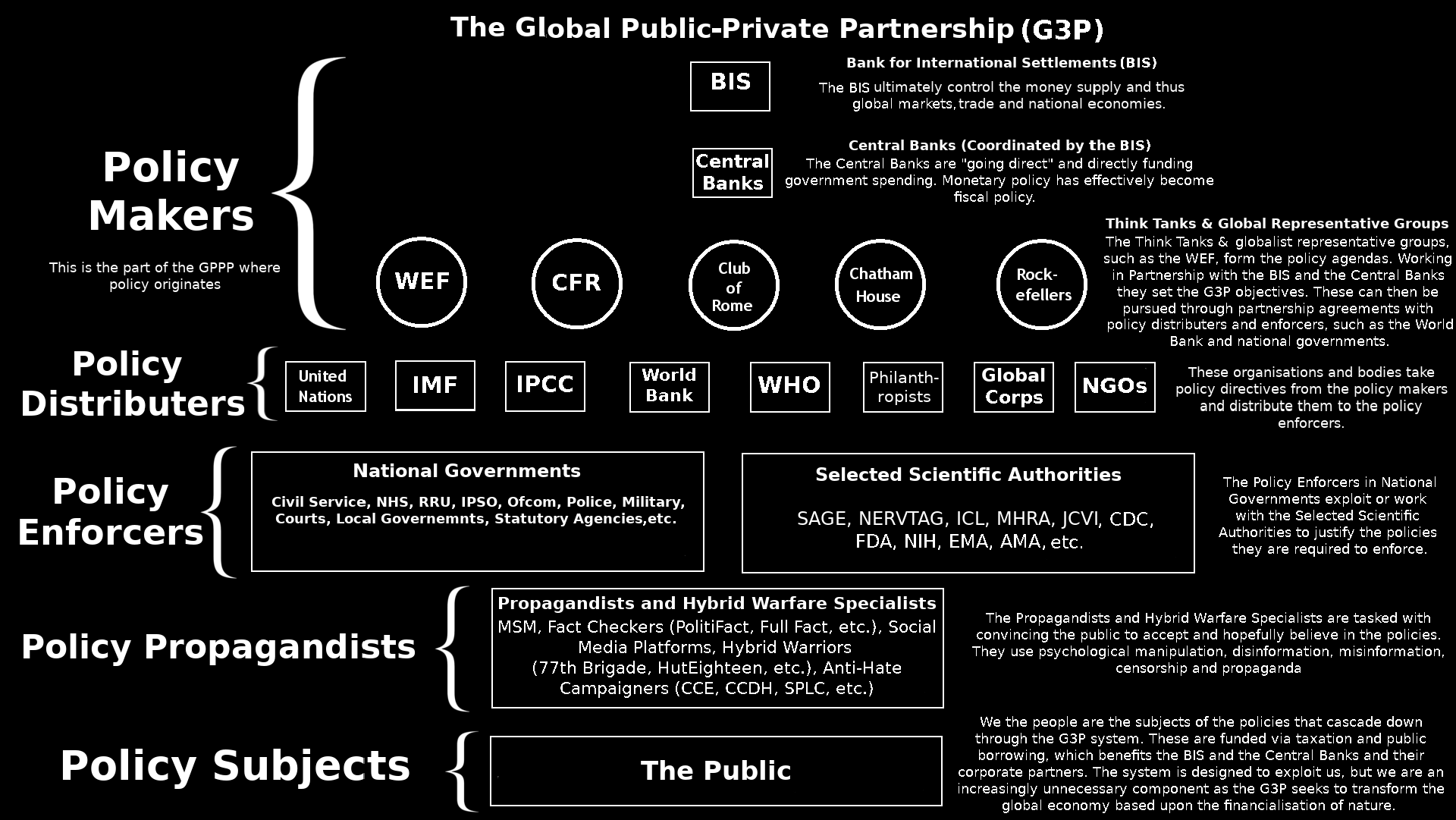
China-maxxing lends internationally approved narrative support to multiparty because it promotes the technocratic digital surveillance that all multipolar regions will use to control their populations. The proposed MWO, which will create what we might call regional-interoperability, is currently being constructed. It is just another attempt to establish a global dictatorship under the centralised authority of the global public-private partnership and, ultimately, of a transnational capitalist parasite class.
****************************
As far as I know, the suspicion is not that UKC is a nest of secret squirrels working for the enemy. The reasonable concern is that there has been a shift in UKC content that correlates with the arrival of Jahnke’s money. Former academic and independent analyst, journalist, and author David Hughes is presumably the “academic” among the “small clique” UKC suspects of involvement in the international conspiracy aiming to take it down. That does not change the fact that Hughes is among the independent journalists who have reported the evidence that poses legitimate questions about the apparent change to UKC content.
Hughes wrote:
Marcel Jahnke, the German businessman who acquired a 20% stake in Akita Media Ltd., which trades as UK Column (UKC) shortly before Nell (Jerm Warfare) and Carl Zha were given their own slots there. Jahnke’s only published interview (paywalled) was with Zha in 2023. [. . .] According to UK Column’s Mike Robinson, “[Jahnke] has no desire to see us headed in any direction other than the one we intended to go in.” Who knew that UKC was already planning to onboard Nell (in May 2025) and Zha and devote an increasing amount of time and attention (and trips) to China from that point on?
Specifically, then, it is the UKC content from Carl Zha and Jerm Warfare that represents the reported “shift.” In its rebuttal (referenced above), UKC acknowledged that the arrival of “new voices” always brings “new perspectives,” and some sort of “editorial shift” inevitably follows. This is entirely as you might expect and is certainly not “improper.”
In my relatively brief experience, UKC content creation is very much a collaborative effort. They invite their freelancers and contributors to work with them to develop content for their audience. In their rebuttal, UKC emphasised that “the one person who has no say editorially is Marcel Jahnke, and at no stage has he ever asked for such editorial control.”
This appears to be a bit of a strawman argument. None of UKC’s recent critics have argued that Jahnke has “editorial control” of UKC. No one is suggesting that UKC has become a slave to the Chinese state or is now under the influence of the United Nations or Donald Trump.
UKC obviously does not just pump out “pro-China” propaganda. This UKC article, for example, written by Dr. Marwa Osman and published by UKC after Janhke invested, is highly critical of the Chinese government.
Vanessa Beeley was at pains to point out to me how critical she, as a UKC freelancer and frequent presenter, is of Chinese government policies. UKC provides her an opportunity to make these public criticisms. Nonetheless, China-maxxing and a pro-MWO content is now readily available on the UKC platform.
For example, at about 17 minutes into this UKC video, posted on 24th November 2025, Carl Zha downplays China’s fierce COVID lockdowns and talks about how lovely it was for Chinese people to be occasionally allowed out of their flats to walk around within the confines of their lockdown compounds. He then extols the alleged benefits of 15-minute cities—the United Nations’ strategy to use digital surveillance technology to enforce SDG11 on the world.
Zha explains how convenient your government-restricted life will be and how you really won’t ever need to leave your 15-minute city compound. Like most Multipolaristas, Zha makes no mention of the wall-to-wall facial recognition, digital ID checks, or technological oppression designed to keep people in their 15-minute city “compounds.” At about the 29-minute mark, Zha briefly notes the “ubiquitous” Chinese smart-city surveillance cameras. He promotes them, saying how safe they make Chinese people feel.
This video from Zha is just one one among many similar reports he and Jerm Warfare have put out on UKC since early 2025. In other words, UKC is publishing pretty standard China-maxxing global governance propaganda quite regularly.
YMS Market Access Ltd. took its 20% stake in Akita Media Ltd. in January 2025. Carl Zha first appeared on UKC on 23rd January 2025. Jerm Warfare soon followed and was introduced to the UKC audience in May 2025.
Correlation is not causation, of course, but the suspicions are obviously valid. UKC’s offered rebuttal does nothing to assuage them. Moreover, UKC’s China-maxxing pro-global governance reports are worthy of criticism regardless of any possible financial inducement.
I’m not sure what UKC’s argument is. It is not really tenable for UKC to maintain that the sudden appearance of this kind of propaganda content on its platform doesn’t correlate with Janhke’s investment. Consequently, it appears UKC is not arguing that point. Instead, it has responded to personal spats and suggested the possibility of deep state plots against it.
I may be jumping the gun here. Via my Telegram channel, Vanessa Beeley informed me that UKC intends to offer a “total rebuttal of all spurious accusations made by [. . .] Ginsburg, Hughes etc.” Perhaps the rebuttal she refers to will be published by UKC in due course.
I don’t see why UKC would be bothered about criticism of its content and I’m sure it isn’t. For UKC, the bone of contention is clearly the widely aired suspicion that the new content may reflect the interest of investors.
As pointed out by Ursula Edgington, audiences and readers “seek out alternative, independent content-creators because they pursue and report truth.” UKC offers itself as the antidote to propaganda. This is doubtless why UKC is hyper-sensitive to the allegation that it is financially compromised. I would be too. For any independent media journalist or outlet, accusation of undeclared paid content is not just a reputation killer it is potentially a means, as Edgington observes, to capture, exploit, demolish and hijack independent media. These are the “lessons” Ginsburg suggests the independent media needs to learn.
Those of us who work in the independent media need to be acutely aware of the risks of accepting large financial contributions from one donor. Especially foreign donors with questionable ties to outlets like the Rising Tide Foundation.
Again, David Hughes reported:
[T]he Foreign Agents Registration Act in the US and similar legislation such as the Foreign Influence Registration Scheme (FIRS) in the UK can be weaponised such that content creators can be accused of receiving support from “foreign agents,” that would be highly dangerous for any dissidents targeted. For example, non-compliance with the FIRS is punishable by up to two or five years in prison and/or fines, depending on whether the offence falls under the “political influence tier” or the “enhanced tier.”
With regard to the latest UKC rebuttal, on her own Telegram channel, UKC freelance presenter Vanessa Beeley wrote:
Sad times when independent media channels are forced to defend themselves against those who should be considered allies. Instead of focusing on the central enemy complex.
Beeley assumes all independent journalists agree on who or what the “central enemy complex” is. The call for unity with UKC is nonsensical when UKC appears to be putting out content that promotes what other independent media journalists consider to be the “central enemy complex.”
With respect to their stated views on multipolarity and some of the views they have expressed about the Chinese government, I don’t agree with virtually anything either Carl Zha or Jerm Warfare have recently argued or presented on UKC. I reject Beeley’s assertion that I must not publicly criticise the reports of other independent media journalists and outlets because I “should” consider them my “allies.” Casting other journalists as traitors to the cause, accusing them of not being “real journalists,” and questioning their principles and morality because they are critical—and have perhaps raised uncomfortable questions—is the argumentation of propagandists who wish to silence critics and shut down open debate.
I don’t care if they are in-house journalists for the Guardian or freelancers producing videos for UKC. If they are China-maxxing and suggesting that global governance is a good idea, they are not my allies, and I reserve the right to make any criticism I like.
It is deeply regrettable that those of us in the independent media who have raised concerns about the new direction of UKC content have perhaps allowed the debate to devolve into what must appear to readers to be an undignified “he said, she said” squabble. I take full responsibility for whatever part I may have played in giving that impression. All I can say is that is not my intention.
In one sense, Vanessa Beeley is right. The issues that we are discussing, the threats we all face, and the need to reach out to people who share the concerns expressed by many independent journalists are too important to be sidelined by petty quarrels, personal animosities, and unprofessional conduct. The independent media can and must, as a whole, do better.
My usual focus is typically on those much more important issues. But I felt this matter was of sufficient weight to warrant an article.
Exploring the evidence and providing readers access to evidence they might not otherwise encounter is why I am so passionate about what I do. My reach is very small, and that is why the information put out by bigger independent media platforms, like UKC, matters to me. I suggest it should matter to all who recognise that we face genuine existential threats. There is no chance that the mainstream media will ever report the truth.
We in the independent media don’t need universal agreement on every single subject. All we need is broad agreement that the current sociopolitical trajectory is towards dictatorship. We can each turn our journalism to exposing this unpalatable truth, and suggest whatever solutions we can, in our own ways.
Part of that collective effort has to include the freedom to criticise each other’s work respectfully. If evidence-based criticism from fellow independent media critics is rebutted with allegations that they are part of an “organized effort to destroy [us],” audiences will switch off and readers will look elsewhere. If that happens, the real independent media will vanish, leaving many people feeling unheard and isolated once again.
****************************




 Please feel free to share anything from iaindavis[.]com excluding any and all third party content. I use a Creative Commons License. All I ask is that you give credit to the author and clearly mark any changes you make. Please share my work widely. Censorship is increasing and we need to get this information out there. If you value what I do then please consider supporting my work. Many thanks.
Please consider supporting my work. I really need your help if I am going to continue to provide the research and analysis that you value on a full-time basis. You can support my work for less than the price of a cup of coffee via my donor page or alternative become a paid subscriber to my Substack.
AI Transparency: I do not use AI to research or write any of my work. I use an AI grammar tool to check the first draft of the completed article because I can’t spell and my grammar is atrocious.
Please feel free to share anything from iaindavis[.]com excluding any and all third party content. I use a Creative Commons License. All I ask is that you give credit to the author and clearly mark any changes you make. Please share my work widely. Censorship is increasing and we need to get this information out there. If you value what I do then please consider supporting my work. Many thanks.
Please consider supporting my work. I really need your help if I am going to continue to provide the research and analysis that you value on a full-time basis. You can support my work for less than the price of a cup of coffee via my donor page or alternative become a paid subscriber to my Substack.
AI Transparency: I do not use AI to research or write any of my work. I use an AI grammar tool to check the first draft of the completed article because I can’t spell and my grammar is atrocious.

I live in Australia. China is by far our largest trading partner – about 4 times higher than the second (Japan) or third (US) largest – which gives it tremendous power over us. That power fits well within the concept of “soft power.” It may be subtle, even covert, but it is pervasive, perhaps even ubiquitous. And sometimes the velvet glove comes off.
I have been following David Hughes’ work, including the stuff on Janhke. The UKC – or better put, the Nell-Zha-Janhke stuff – has been a bit of a yawnfest for me, because China’s intentions across the globe are so patently obvious from where I sit and watch the world.
To me, it doesn’t matter who is talking up China; they are either ignorant fools or they’ve been bought. Simple as that. So, UKC columnists and staff, which is it?
Thanks for clarifying your position for your regular readers, Iain. I did wonder when you published such a congenial interview with Jeremy Nell. 🙂
Admirable input Iain.
Mines need to be disabled if possible.
Not just avoided.
UKC can focus on perceived criticism from within.
Or on the writing on the wall.
Thank you, Iain!!
‘If evidence-based criticism from fellow independent media critics is rebutted with allegations that they are part of an “organized effort to destroy [us],” audiences will switch off and readers will look elsewhere’.
I did that with UKC some time ago because, increasingly, my senses have led me to the very few who do not compromise on truth.
I am surprised that you have not mentioned UKC very obvious pro Russia Bias. I understand the need to counter the historic and constant ongoing west propaganda against Russia. But you should still be able to criticism Russia. I think Putin and who ever is backing or controlling him is finding a state of war very useful and is in no hurry to end the war.
I don’t agree on UKC position that we need a stronger military.
I think people should not be thin skinned and be able to take criticism and reply when needed in a constructive way. We live in a money based system so hard to remain independent. I always try to take the good and ignore the bad. I hope that UKC does not get as Pro China as they have been Russia. I think UKC does some very good work in tracking the changing UK laws designed to restrict our freedom
I agree Brian. It does do a lot of good work. I did try to emphasise that point in the article. With Regard to Russian bias, yes I think UKC content in the past has shown some Russian government bias.
I have seen comments under the Michael Ginsburg ‘Actionable Truth’ YouTube video that UKC presenter/contributor Charles Mallet is formerly of Eton and has a questionable bloodline. No details given. Mr Mallet did seem to come from nowhere though, to the head of UKC. That is unusual in my experience. The name Rubin was mentioned but I thought maybe that was a reference to UKC presenter Ben Rubin.
Since I became a UKC member,I have wondered about the many ex-military’links UKC has, and of course ex GCHQ. Or am I just paranoid ?
Not paranoid, no. UKC has always been run by figures close to the British Establishment. It is not unreasonable to question this but, similarly, it doesn’t mean there is anything untoward for an self-proclaimed independent media outlet. I think we need to be careful to stick to evidence and avoid speculation and wild rumours. I note Charles Mallet has issued a legal notice of sorts to Sandi Adams.
https://www.ukcolumn.org/article/claims-made-by-sandi-adams-about-charles-malet
I have been criticised for sharing that Ginsburg interview and I think the criticism is fair. There was a lot of evidence-free specualtion and personal accusation in it. I should have qualified my sharing of it more carefully. Though I didn’t expect such a fuss to be made out of it given that I only shared it on my relatively small and wholly inconsequential Telegram Channel. Nonetheless, Malet has every right to deny any spurious allegations made about him in public. If I felt as aggreived as he evidently does, I would do the same.